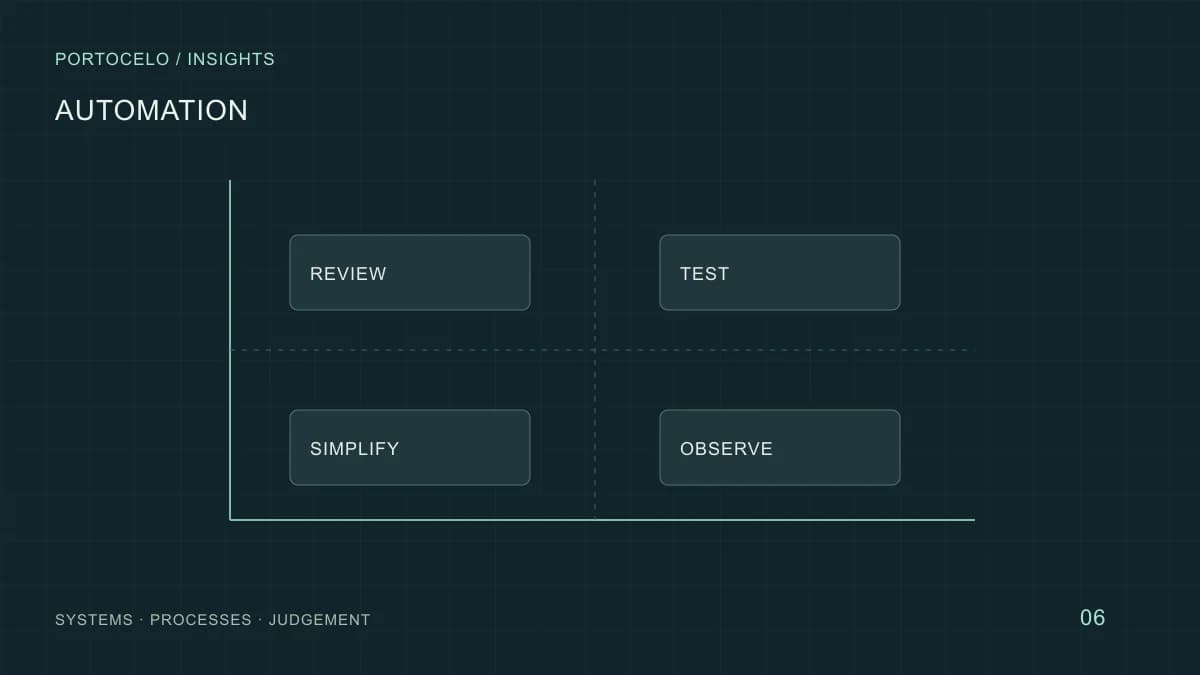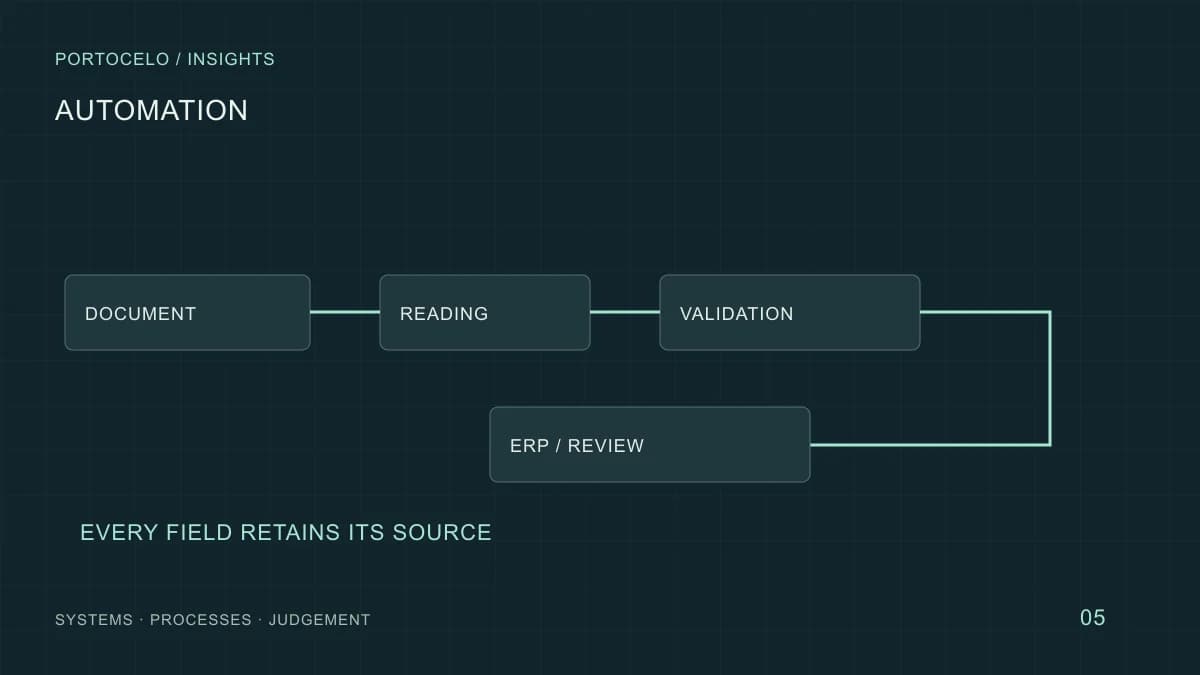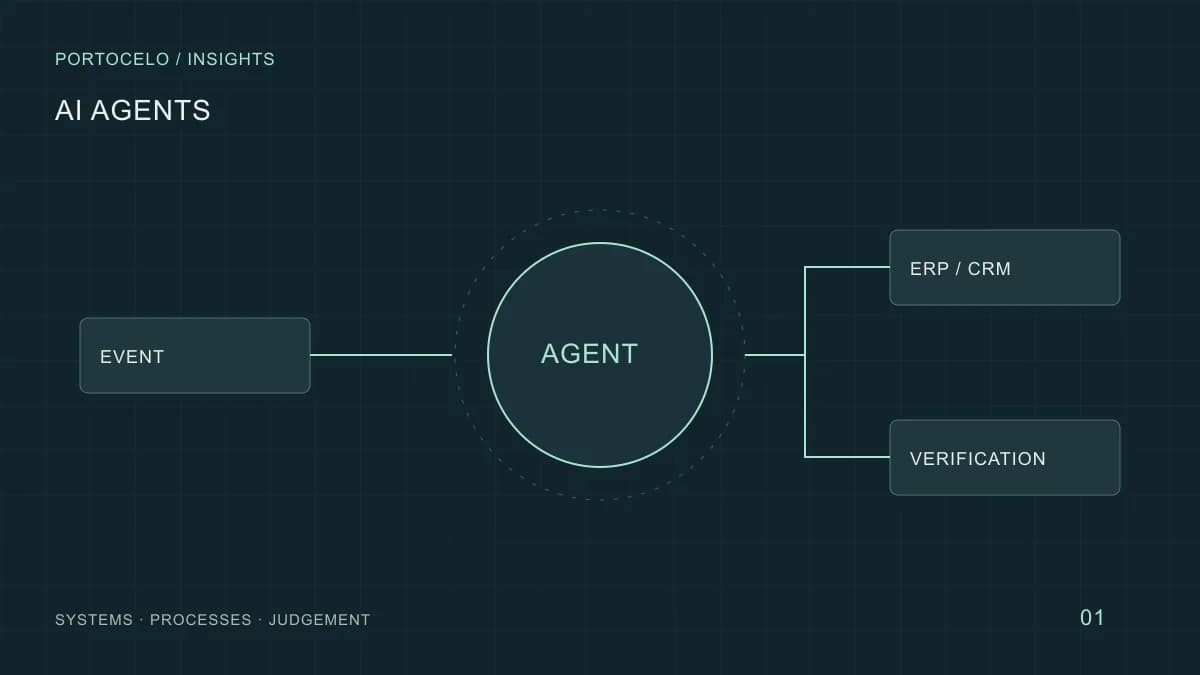
Reading an email, finding an order and drafting a reply can be combined in an AI-supported flow. That does not mean the whole process should run without people. The useful part is often between an unstructured input and an output that someone can verify.
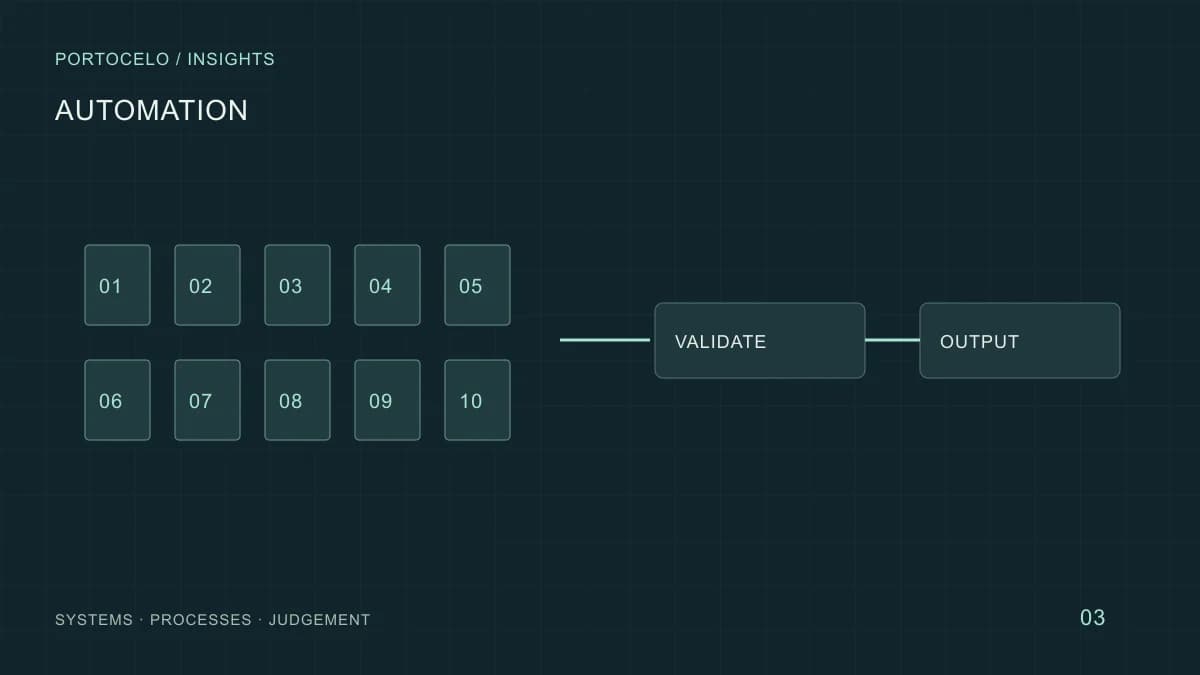
These ten examples are possible designs, not savings promises or customer results. Each separates the model’s task, the required integration and the review step so you can recognise a process in your organisation and prepare an initial assessment.
AI adoption is growing; the decision is still about the process
Eurostat reported that 20.0% of EU enterprises with at least ten employees used AI technologies in 2025, up from 13.5% in 2024. This measures adoption in surveyed sectors, not profitability or the likely outcome of a particular implementation. Source checked on 29 September 2026.
% of enterprises · 2024–2025
Enterprises with at least ten employees in the sectors covered by Eurostat’s ICT survey; this is not a Portocelo result.
Source: Eurostat · isoc_eb_ai · 11 December 2025. Source publication: .
The better starting question is whether you can describe the input and recognise a correct outcome. Each example below makes those boundaries explicit.
1. Incoming invoices
| Part of the process | Proposed design |
|---|---|
| Input | A PDF invoice and, where available, a purchase-order reference. |
| What AI does | Extract fields and suggest supplier and order matches; use rules for totals and duplicates. |
| Required system | Email or intake portal, supplier catalogue and ERP. |
| Human involvement | Check conflicting amounts, changed bank accounts and ambiguous references; payment approval remains separate. |
| Expected result | A draft accounting record linked to the invoice and review reasons. |
Distinguish an invoice from a credit note or pro forma. A legible number may still be assigned to the wrong field.
2. Email routing
| Part of the process | Proposed design |
|---|---|
| Input | Messages in a shared inbox with an agreed taxonomy. |
| What AI does | Suggest category, operational priority and receiving team. |
| Required system | Email, task queue and team directory. |
| Human involvement | Review ambiguous messages, complaints and deadline-sensitive requests. |
| Expected result | An ordered queue with draft assignments and the original message preserved. |
Instructions from a sender cannot expand the system’s permissions.
3. Document classification
| Part of the process | Proposed design |
|---|---|
| Input | Recurring document types in PDF or image form. |
| What AI does | Suggest type and metadata, separating mixed documents when feasible. |
| Required system | Document repository and text extraction or OCR. |
| Human involvement | Check new types, incomplete files and consequential classifications. |
| Expected result | Documents ready for filing, with suggested categories and provenance. |
An “undetermined” category is safer than forcing a guess.
4. CRM update preparation
| Part of the process | Proposed design |
|---|---|
| Input | An authorised meeting note or commercial message. |
| What AI does | Suggest fields to update and summarise the next step. |
| Required system | CRM API with account-level access rules. |
| Human involvement | Confirm commitments, dates and the correct contact or company. |
| Expected result | A reviewable update with a history of changed fields. |
A stated intention is not a closed sale or a contractual status.
5. Support drafts
| Part of the process | Proposed design |
|---|---|
| Input | A question and current product or service documentation. |
| What AI does | Retrieve sources and draft a relevant answer. |
| Required system | Ticketing system and permission-aware knowledge base. |
| Human involvement | Review unsupported answers, sensitive cases and critical configuration changes. |
| Expected result | A cited draft that reduces manual searching. |
If the guide does not cover the product version, the system should say so.
6. Request data extraction
| Part of the process | Proposed design |
|---|---|
| Input | A form or email with expected fields. |
| What AI does | Identify fields and flag missing information without inventing it. |
| Required system | Destination application and format-validation rules. |
| Human involvement | Resolve contradictions and verify data used in a decision. |
| Expected result | A record pending validation with provenance for each field. |
“Not found” and “no” are different results.
7. Quote preparation
| Part of the process | Proposed design |
|---|---|
| Input | A request and an authorised, current catalogue and price list. |
| What AI does | Match the need to catalogue items and prepare an initial proposal. |
| Required system | Catalogue, pricing system and sales application. |
| Human involvement | Approve price, discounts, scope and commitments before sending. |
| Expected result | A draft that focuses human review on the solution and terms. |
Use rules for tax and totals instead of free-form model arithmetic.
8. Minutes and meeting tasks
| Part of the process | Proposed design |
|---|---|
| Input | Notes or a recording collected and processed under applicable conditions. |
| What AI does | Draft a summary, decisions and tasks, separating decisions from discussed ideas. |
| Required system | Authorised repository and task manager. |
| Human involvement | Verify attribution, owners, dates and transcription errors. |
| Expected result | Draft minutes and tasks that people can accept. |
Do not assign a commitment to somebody who merely asked a question.
9. Recurring reports
| Part of the process | Proposed design |
|---|---|
| Input | Structured data and agreed definitions of indicators. |
| What AI does | Explain changes on top of verified calculations. |
| Required system | Database, controlled queries and reporting tool. |
| Human involvement | Check causal claims and possible source-data errors. |
| Expected result | A report with traceable figures and hypotheses clearly marked. |
A rise in a metric does not prove its cause.
10. Internal knowledge search
| Part of the process | Proposed design |
|---|---|
| Input | A question and documents the user may access. |
| What AI does | Retrieve passages and answer with verifiable citations. |
| Required system | Corporate identity, document index and access control. |
| Human involvement | Review unanswered questions, conflicting sources and higher-impact uses. |
| Expected result | An answer that opens its supporting documents. |
Index updates and access revocation are ongoing operational duties.
How to choose the first process
Choose a task with an owner and enough volume to observe routine cases and exceptions. Document how people solve it now, including corrections absent from the formal procedure. If input data is inconsistent, improve it before adding a model.
| Question | Good sign for a pilot | Before automating |
|---|---|---|
| Is it repeated often enough? | Recurring comparable outcomes | Observe a representative period |
| Can the output be verified? | A source or rule exists | Agree who judges correctness |
| Can systems be accessed? | Stable authorised API or exchange | Resolve permissions and supplier dependencies |
| Do exceptions have an owner? | A queue, reviewer and manual route | Agree review capacity |
| Is an error reversible? | A draft or recoverable operation | Separate proposal from execution |
Do not turn these answers into a sales score: one missing permission can block the project. The guide to selecting a process develops this decision.
Measure without promising a savings percentage
Record total time per task, relevant errors and backlog before a pilot. Compare equivalent cases afterwards, including review, corrections and incidents. Split results by input type so easy cases do not hide deterioration in difficult ones.
An initial estimate can start with time freed in correctly completed tasks, multiplied by observed volume, then subtract review and maintenance. Free time may reduce delays or improve service rather than become cash savings. Also include integration, licences, infrastructure and ongoing ownership.
Before expanding, check that somebody can maintain rules and sources. Our automation service can turn an example into a testable scope.
From knowledge to a working process
Choose a process and map the flow.
Tell us what information arrives, where it is recorded and which exceptions consume the most time.
Review your process ↗